Oct 1, 2026Product News
Accessory Industry Roundup, October 2026: Docking Stations Keep Climbing, Thunderbolt 5 Goes Mainstream, and EU Rules Reshape USB-C
Docking station demand keeps climbing, Thunderbolt 5 docks hit the market, and the EU's USB-C laptop rule is reshaping accessory buying. Mattzon's October 2026 industry roundup explains what it means
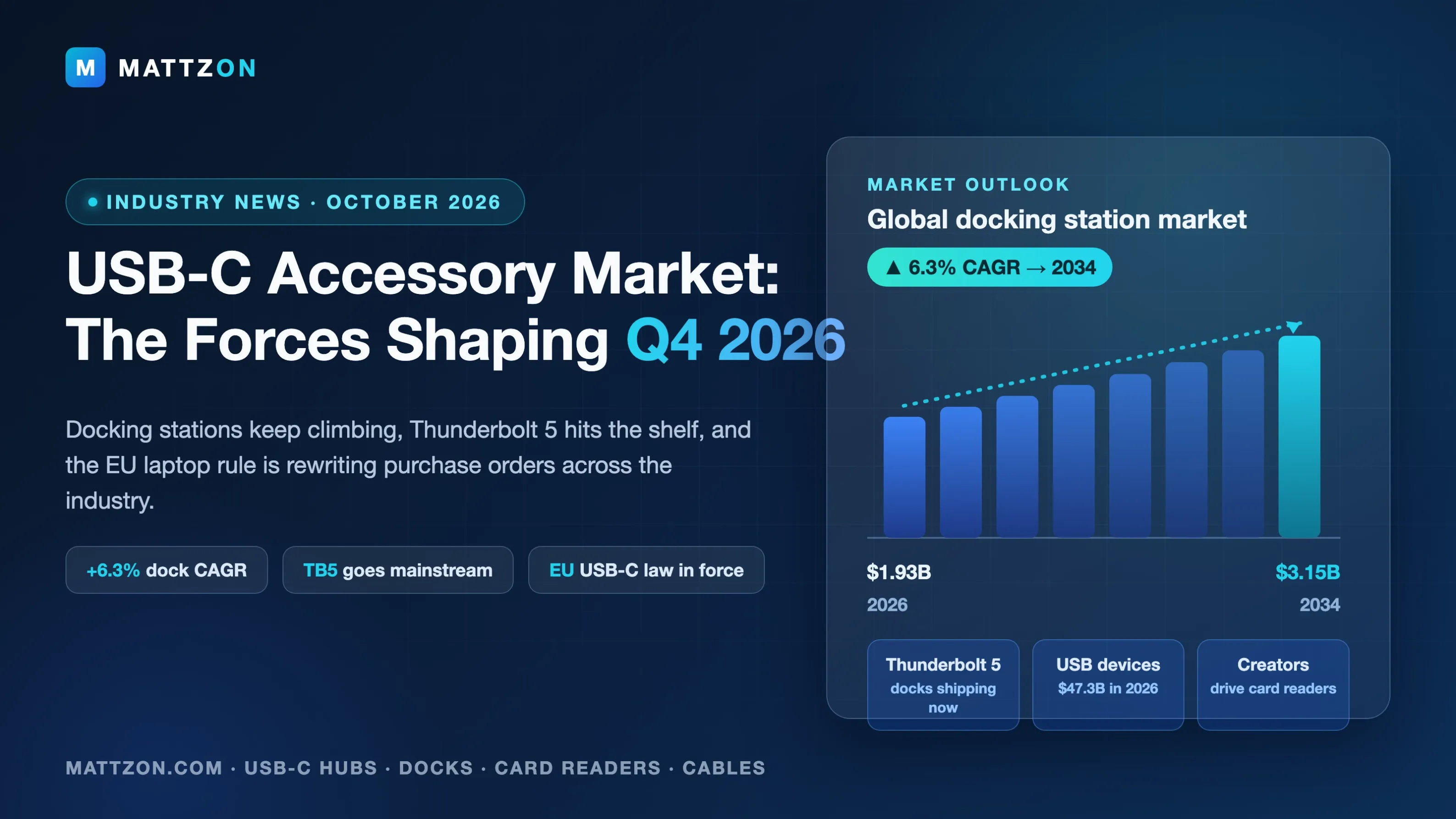
The USB accessory business has entered the last quarter of 2026 with three storylines running at once: steady market growth, a new generation of high-bandwidth standards going mainstream, and regulatory pressure that is quietly changing what buyers put on their purchase orders. Here is our monthly roundup of the news that matters to hub, dock, cable and card reader buyers.
Docking stations: a market that keeps compounding
Analysts covering the docking station segment continue to revise their forecasts upward. Fortune Business Insights projects the global docking station market to grow from roughly USD 1.93 billion in 2026 to USD 3.15 billion by 2034, a compound annual growth rate of about 6.3%, while other research houses put the 2026 figure anywhere between USD 2 billion and USD 4 billion depending on how docks are categorized. The USB hub segment tells a similar story: Business Research Insights values it at around USD 780 million in 2026, heading toward USD 1.4 billion by 2035 at roughly 7% annual growth.
Two demand engines sit behind these numbers. The first is the hybrid office: employees who split time between home and the workplace are standardizing on single-cable USB-C desk setups, and IT departments are buying docks in volume rather than one at a time. The second is the AI PC refresh cycle — the 2025–2026 wave of new Windows laptops is prompting corporate buyers to re-evaluate their entire desktop ecosystem, docks and hubs included. Because every new laptop ships with a shrinking set of ports, the accessory attach rate keeps rising.
Thunderbolt 5 moves from spec sheet to shelf
After two years of paper launches, Thunderbolt 5 hardware is finally shipping in volume. Apple's latest MacBook Pro models now include Thunderbolt 5 ports with DisplayPort 2.1-class video bandwidth, and third-party docks — such as the HyperDrive Next Thunderbolt 5 dock introduced earlier this year — are advertising up to 120 Gbps of display bandwidth, triple the figure of Thunderbolt 4.
For accessory brands, the message is not "Thunderbolt 4 is dead." It is backward compatible, and for most desks a TB4 or USB4 dock is still more than enough. The opportunity is at the top of the market: video editors, engineers and gamers are starting to ask for 80G/120G-class connectivity, and brands that have an 80Gbps-ready line — hubs, docks and cables designed around USB4 v2 and Thunderbolt 5 silicon — are the ones winning those requests for quotation. Expect 2027 catalogues to treat "TB5-compatible" the way they treated "8K-ready" two years ago: a premium line above the standard range.
The EU laptop deadline has landed — and it is changing purchase orders
The biggest regulatory story of the year quietly became reality on 28 April 2026: under the EU Common Charger Directive (Directive (EU) 2022/2380), all new laptops sold in the European Union must charge over USB-C with USB Power Delivery. The first phase of the rule already covered smartphones, tablets, cameras, headphones and most portable devices from December 2024; laptops were given the longest transition because of their design complexity.
What is less discussed is the knock-on effect on accessories. Retail chains and e-tailers across Europe are increasingly asking suppliers for:
- Certified, standards-compliant accessories — hubs, docks and cables that play by USB PD and USB-IF rules rather than cutting corners;
- Correct labeling, including the new EU common charger pictograms where applicable;
- Documentation packs — CE, RoHS, REACH and FCC reports that can survive retail compliance audits.
For importers, the compliant-supplier list is getting shorter. Factories that invested early in certification and standardized USB-C designs are picking up volume that used to flow to no-name suppliers.
Where the growth is: creators, cars and control rooms
Beyond the office, two niches are outgrowing the market. Content creation remains the strongest: mirrorless cameras shooting 6K–8K video, drones and action cams generate enormous files, and that is pulling demand for high-speed card readers — UHS-II SD, SD 4.0 and CFexpress — as well as NVMe SSD enclosures for on-set offloading. Meanwhile, KVM switches and multi-host docks are riding the wave of multi-PC workstations, from trading desks to home offices that mix a work laptop and a personal gaming rig.
What this means for buyers heading into 2027
- Anchor your range on USB-C. It is now the legal baseline in the EU and the practical baseline everywhere else.
- Add one premium tier. An 80Gbps-ready dock or a CFexpress reader differentiates your catalogue without cannibalizing volume SKUs.
- Treat compliance as a selling point. CE/FCC/RoHS/REACH documentation and factory audit reports close retail deals that price alone cannot.
- Choose suppliers who can move fast. Market windows in accessories are measured in months; a factory that turns a sample in days and a private-mold order in weeks is worth real margin.
-
At Mattzon, we are watching these shifts from the factory floor. Our USB-C hub, docking station, cable and card reader lines are built for exactly this market — certified, private-mold designs with no MOQ for stock models and 3–25 day lead times. If you are planning your 2027 range, talk to us before your competitors do: info@mattzon.cn or WhatsApp +86 18681462886.
Sources: Fortune Business Insights (docking station market), Business Research Insights (USB hub market), European Commission (Common Charger Directive), Thunderbolt/USB4 product announcements, September–October 2026.